All published articles of this journal are available on ScienceDirect.

Accuracy of Four Intravenous Infusion Devices in a Clinical Setting: A Randomized Controlled Trial

Abstract
Introduction/Objective
Accurate delivery of intravenous fluids is essential for patient safety, but the flow rate accuracy of different infusion devices in clinical settings remains incompletely characterized. This study aims to compare the flow rate accuracy of four intravenous infusion devices-Terufusion TE-112, Volumed μVP7000, Auto Clamp, and Infucon-across multiple flow rates in patients undergoing elective surgery under general anesthesia.
Methods
In this single-center, randomized controlled trial, 80 adult patients (ASA physical status 1–2) scheduled for elective surgery of more than 2 hours were randomized to one of four infusion device groups (n = 20 per group). Each device delivered 0.9% normal saline at set flow rates of 10, 50, 100, and 200 mL/h for 30 minutes each. Delivered volumes were calculated by gravimetric measurement using a calibrated electronic balance. Accuracy was expressed as delivered/set flow rate (%). Between-group differences were analyzed using a Linear Mixed-Effects Model (LMEM) and Wilks' lambda MANOVA.
Results
LMEM revealed a significant between-group difference (F[3,313] = 5.690, P = 0.001). Infucon consistently over-delivered compared with all other devices (MANOVA: F(12,193.43) = 11.983, p < 0.001; λ = 0.230). Mean overall accuracies were: Terufusion TE-112, 96.72 ± 0.98%; Volumed μVP7000, 96.35 ± 1.34%; Auto Clamp, 100.19 ± 0.88%; and Infucon, 110.31 ± 1.88%. Infucon exceeded ±10% error at 10 mL/h (+17.25%) and 50 mL/h (+10.16%). Bland–Altman overall limits of agreement were ±1.92, ±2.62, ±1.72, and ±3.68 mL, respectively.
Discussion
Three intravenous infusion devices accurately administered drugs within ±10% of the set flow rate under all test conditions. The gravity flow controller (Infucon) was consistently overdosed, reaching an average accuracy of 110.31%, particularly at low flow rates, with clinically meaningful implications for fluid and drug management.
Conclusion
Three of the four tested infusion devices demonstrated clinically acceptable flow-rate accuracy across all tested conditions. The gravity-type flow regulator (Infucon) showed significant over-infusion.
1. INTRODUCTION
Intravenous fluid therapy is one of the most frequently performed clinical interventions in perioperative medicine. Accurate delivery is fundamental to hemodynamic stability and drug dosing, as both over- and under-infusion independently increase morbidity and mortality [1, 2].
Infusion devices range from electromechanically controlled positive-pressure volumetric pumps to passive gravity-dependent flow regulators. Positive-pressure devices are relatively insensitive to changes in downstream resistance and viscosity [3]. In contrast, gravity-dependent devices are inherently susceptible to fluctuations in fluid height, line resistance, and patient movement [4].
In vitro studies have demonstrated that peristaltic volumetric pumps achieve accuracy within ±5–10%, whereas gravity-type regulators show substantially greater variability, particularly at low flow rates. A recent systematic review further confirmed that height, back pressure, viscosity, and patient position all significantly impact gravity-device accuracy [5]. Flow continuity studies have also shown that certain pump configurations deliver non-continuous flow at very low rates, with particular clinical relevance in pediatric settings where concentrated agents are infused at low rates.
Despite these in vitro insights, the translational validity to clinical environments remains underaddressed. In vivo performance is subject to additional variables including venous back pressure, patient movement, and catheter-related resistance [6]. These factors may either attenuate or exacerbate the accuracy differences observed in vitro. Prior research from this group, conducted in a controlled in vitro environment, demonstrated that among four devices commonly used in Korean clinical practice-Terufusion TE-112 (peristaltic volumetric pump), Volumed μVP7000 (syringe-based volumetric pump), Auto Clamp (peristaltic positive-pressure regulator), and Infucon (gravity-type flow regulator)-all except Infucon maintained delivery accuracy within ±10% across all conditions tested, while the Infucon exhibited significant over-delivery with crystalloid infusate and marked under-delivery with colloid and concentrated glucose solutions [7].
The primary objective of this randomized controlled trial aimed to compare the flow rate accuracy of these four devices across clinically relevant flow rates (10, 50, 100, and 200 mL/h) in adult surgical patients, hypothesizing that positive-pressure devices would demonstrate superior accuracy [7], and that these differences would be clinically meaningful-exceeding ±10% deviation at one or more flow rate settings. The reliability of each device was assessed as a secondary outcome using Bland–Altman limits of agreement.
2. METHODS
2.1. Study Design and Registration
This was a single-center, open-label, parallel-group, superiority randomized controlled trial conducted at Chung-Ang University Hospital in Seoul, South Korea, between September 2016 and February 2017, and reported in accordance with the CONSORT 2010 guidelines [8]. The study was approved by the Institutional Review Board of Chung-Ang University Hospital (Ref. C2015034(1492)). The study was conducted in accordance with the Declaration of Helsinki (2000 revision), and written informed consent was obtained from all participants prior to inclusion. This study was not registered in a clinical trial registry. At the time of study conduct (2016–2017), prospective registration was not mandated by the institutional ethics committee for device performance evaluation studies. Furthermore, because this study evaluated the technical accuracy of commercially approved infusion devices rather than the efficacy or safety of a pharmacological intervention, it did not meet the criteria for mandatory trial registration under the International Committee of Medical Journal Editors (ICMJE) guidelines in effect at the time.
2.2. Participants
Adult patients (aged 20–65 years) with ASA physical status 1 or 2 who were scheduled for elective surgery expected to last more than 2 hours were considered for inclusion. Patients were excluded if they had right ventricular dysfunction, cardiac rhythm other than normal sinus rhythm, valvular heart disease, pulmonary arterial hypertension, peripheral vascular disease, severe respiratory, renal, or hepatic disease, obesity (body mass index > 30 kg/m2), or a psychological disorder. These criteria were applied to minimize hemodynamic and vascular confounders that could independently affect infusion line resistance and flow characteristics.
2.3. Sample Size
The sample size was calculated based on the primary outcome of delivered flow rate accuracy at 100 mL/h, informed by a prior in vitro study in which the overall standard deviation of infused volume at 100 mL/h was 2.24 mL [7]. Assuming a target 95% CI width of 2 mL (±1 mL), a two-sided alpha of 0.05, and a power of 80%, a minimum of 20 participants per group was required. Sample size calculations were performed using PASS 11 software (NCSS, Kaysville, UT, USA). The final target was 20 patients per group (80 total).
2.4. Randomization and Allocation Concealment
Randomization was performed using a computer-generated random number sequence with blocks of four (Wei's Urn model, PASS 11). An independent statistician generated the randomization table. Allocation concealment was maintained using sequentially numbered, sealed opaque envelopes. Blinding of care providers was not feasible given the nature of the intervention; however, the outcome assessor performing gravimetric measurements was blinded to device assignment throughout.
2.5. Interventions
Four intravenous infusion devices were evaluated, all newly unopened: (1) Terufusion TE-112 (Terumo Corporation, Tokyo, Japan): peristaltic volumetric pump; (2) Volumed μVP7000 (Arcomed AG, Regensdorf, Switzerland): syringe-based volumetric pump; (3) Auto Clamp (ACE Medical, Seoul, Republic of Korea): peristaltic positive-pressure flow regulator; (4) Infucon (Sungwon Medical, Seoul, Republic of Korea): gravity-type flow regulator. After hemodynamic stabilization under general anesthesia, the assigned device was connected via a three-way stopcock to the patient's intravenous access, placed 80 cm above the catheter insertion site, and programmed to deliver 0.9% normal saline at 10, 50, 100, and 200 mL/h for 30 minutes each.
2.6. Outcome Measures
The primary outcome was the accuracy of infusate delivery, defined as delivered flow rate divided by set flow rate (%). Delivered volume was determined gravimetrically using a calibrated electronic balance (AP210, Ohaus, Omaha, NE; accuracy to 3 decimal places). Volume was calculated by dividing weight change (g) by the specific gravity of 0.9% normal saline (1.0046 g/mL). All measurements were conducted at 20–22°C. The secondary outcome was the reliability of flow rate delivery, assessed using Bland–Altman limits of agreement [9].
2.7. Statistical Analysis
The primary outcome was evaluated using a Linear Mixed-Effects Model (LMEM) with flow rate setting and device group as fixed effects, and individual patients as random effects. Because Mauchly's test indicated violation of sphericity (χ2(5) = 15.407, p = 0.009, W = 0.814), Wilks' lambda MANOVA was used for repeated measures analysis. Post-hoc between-group comparisons at each flow rate were performed using one-way ANOVA with Bonferroni correction (α = 0.0125). All analyses were performed using SPSS version 18.0 (IBM Corp., Armonk, NY). A two-sided p-value < 0.05 was considered statistically significant.
3. RESULTS
3.1. Participant Flow and Baseline Characteristics
Between September 2016 and February 2017, 85 patients were assessed for eligibility. Five patients were excluded prior to randomization: three did not meet inclusion criteria, and two declined to participate. Eighty patients were randomized (n = 20 per group). All 80 completed the full protocol and were included in the primary analysis. The CONSORT flow diagram [8] is presented in Fig. (1).
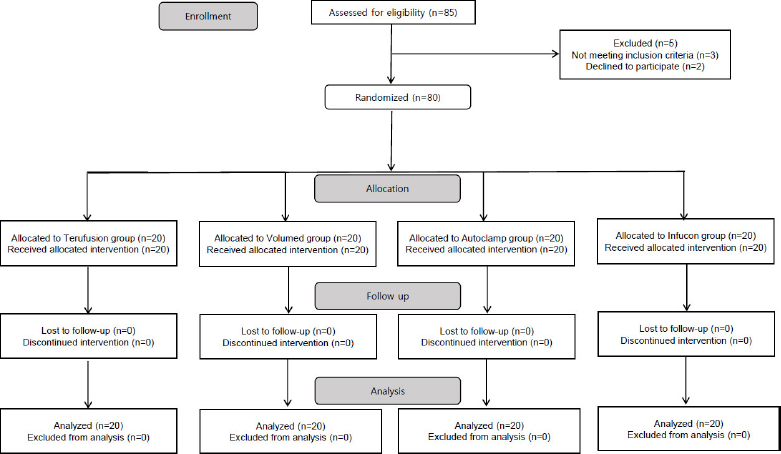
CONSORT flow diagram of participant enrollment, allocation, follow-up, and analysis.
Baseline characteristics are summarized in Table 1. There were no statistically significant between-group differences in any demographic or clinical variable, confirming successful randomization.
| - | Terufusion TE-112 | Volumed μVP7000 | Auto Clamp | Infucon | P-value |
|---|---|---|---|---|---|
| Age (yrs) | 44.0(32.3-51.0) | 26.5(23.3-41.3) | 29.5(23.5-38.0) | 43.5(22.8-52.8) | 0.210 |
| Sex M/F (n) | 5/15 | 9/11 | 6/14 | 7/13 | 0.581 |
| ASA classⅠ/Ⅱ(n) | 14/6 | 16/4 | 16/4 | 13/7 | 0.627 |
| Height (cm) | 162.0 ± 10.4 | 168.5 ± 6.5 | 165.8 ± 11.0 | 164.9 ± 9.8 | 0.173 |
| Weight (kg) | 58.0(54.0-67.0) | 62.5(56.3-66.0) | 58.5(49.5-70.5) | 54.0(50.8-65.8) | 0.567 |
| Operation time(min) | 207.5(167.5-275.0) | 185.0(157.5-218.8) | 175.0(160.0-221.3) | 177.5(151.3-230.0) | 0.286 |
Data are presented as median(Q1-Q3) and compared using Kruskal-Wallis test, because of abnormal distribution.
3.2. Primary Outcome: Infusion Accuracy
The LMEM revealed a statistically significant difference in infusion accuracy between device groups (F[3, 313] = 5.690, P = 0.001). MANOVA confirmed a statistically significant between-group difference (F(12, 193.43) = 11.983, p < 0.001; λ = 0.230). There was no evidence of difference for measured flow rate (%) among Terufusion TE-112, Volumed μVP7000, and Auto Clamp groups at each set flow rate. However, measured flow rates were significantly higher in the Infucon group than in the Terufusion TE-112, Volumed μVP7000, and Auto Clamp groups at each set flow rate (Fig. 2). Compared with Infucon, estimated mean differences (95% CI) in accuracy were: −14.72 (−16.60 to −12.83) for Terufusion TE-112, −14.23 (−16.12 to −12.35) for Volumed μVP7000, and −10.41 (−12.30 to −8.53) for Auto Clamp, all reflecting consistent over-delivery by Infucon at every flow rate tested. Infucon exceeded the ±10% deviation threshold at the 10 mL/h setting (+17.25%) and the 50 mL/h setting (+10.16%); no other device exceeded this threshold at any flow rate. Flow rate-specific results are presented in Table 2.
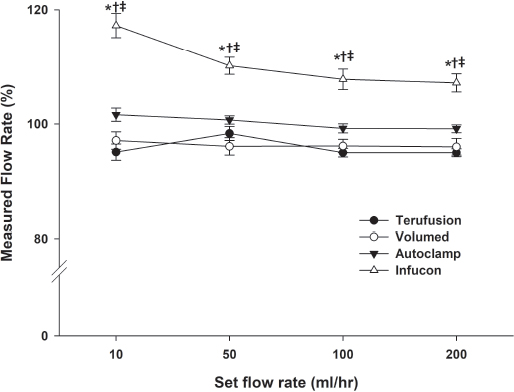
Pump flow rate as a percentage of the rate at which the pump was set. The infusate was a crystalloid solution, and an 18-gauge catheter was used. Data are presented as mean ± standard error. * P < 0.05 compared with Terufusion. † P < 0.05 compared with Volumed. ‡ P < 0.05 compared with Auto Clamp.
| Flow Rate | Terufusion TE-112 | Volumed μVP7000 | Auto Clamp | Infucon |
|---|---|---|---|---|
| 10ml/hr | 95.10 ± 1.43 | 97.12 ± 1.51 | 101.61 ± 1.14 | 117.25 ± 2.12 |
| 50ml/hr | 98.35 ± 1.22 | 96.10 ± 1.51 | 100.70 ± 0.72 | 110.16 ± 1.51 |
| 100ml/hr | 95.01 ± 0.76 | 96.17 ± 1.15 | 99.23 ± 1.55 | 107.78 ± 1.78 |
| 200ml/hr | 95.01 ± 0.68 | 96.02 ± 1.45 | 99.16 ± 0.68 | 107.16 ± 1.59 |
| Overall | 96.72 ± 0.98 | 96.35 ± 1.34 | 100.19 ± 0.88 | 110.31± 1.88 |
3.3. Reliability: Bland–altman Limits of Agreement
Overall Bland–Altman limits of agreement were: ±1.92 mL (Terufusion TE-112), ±2.62 mL (Volumed μVP7000), ±1.72 mL (Auto Clamp), and ±3.68 mL (Infucon). Infucon showed the widest limits of agreement across all individual flow-rate settings, confirming its inferior reliability relative to the other three devices.
4. DISCUSSION
In this single-center randomized controlled trial involving 80 adult patients undergoing elective surgery under general anesthesia, three of the four tested intravenous infusion devices-Terufusion TE-112, Volumed μVP7000, and Auto Clamp-delivered fluids within ±10% of the set flow rate across all tested conditions (10–200 mL/h). The gravity-type flow regulator (Infucon) significantly and consistently over-delivered, with deviations reaching +17.25% at 10 mL/h and +10.16% at 50 mL/h, and an overall mean accuracy of 110.31 ± 1.88%. These findings were consistent with previously established in vitro by our group [7], thereby confirming the translational validity of laboratory-based infusion device benchmarking to the intraoperative clinical environment [10].
Our in vivo results closely mirror the patterns reported in our prior in vitro investigation [7]. In that study, the Infucon delivered an average of 8.98% more crystalloid infusate than the set volume under standard conditions, while the Terufusion TE-112, Volumed μVP7000, and Auto Clamp each delivered within approximately ±2.5% of the set volume. In the current in vivo study, the degree of over-delivery by Infucon was even more pronounced-particularly at low flow rates-suggesting that real clinical conditions amplify rather than attenuate the inaccuracy of gravity-driven devices. This is consistent with established understanding of gravity-type regulator physics: as set flow rates decrease, the fractional impact of any given increment of venous back pressure or line resistance on the actual flow rate becomes proportionally greater, leading to larger percentage deviations [6, 11, 12]. This amplification is further compounded by clinical variables such as central venous pressure and vertical pump displacement, both of which independently alter fluid delivery dynamics in real-world settings [13, 14]. In contrast, the active electromechanical driving force of positive-pressure devices maintains target flow rates independent of downstream resistance fluctuations within the operating range, explaining their consistent performance across all tested conditions [15, 16].
The clinical significance of Infucon's over-infusion behavior extends well beyond its statistical significance. A consistent 10–17% overdelivery at low flow rates could result in inadvertent excess administration of fluid or drugs, with direct patient safety implications. For vasoactive drug infusions-where even small changes in delivery rate may produce clinically important hemodynamic oscillations [17, 18]-or anticoagulant therapy where over-delivery carries hemorrhagic risk, the magnitude of inaccuracy observed with Infucon is clinically unacceptable. Equally, in fluid-restricted patients or those with impaired cardiac or renal reserve, where the consequences of even modest volume overload may be severe [1, 19], a systematic 10–17% excess delivery at the most commonly used low infusion rates represents a meaningful patient safety risk. The finding that this inaccuracy is maximal at the lowest tested flow rates (10 and 50 mL/h) is of particular concern, since low-rate infusions are disproportionately used for pharmacologically active agents requiring precise titration.
The wider Bland–Altman limits of agreement for Infucon (overall ±3.68 mL vs. ±1.72–2.62 mL for the other devices) confirm that its inferior accuracy is not only due to systematic bias but also to greater patient-to-patient variability, making its behavior in individual patients substantially less predictable [9]. This unpredictability is particularly relevant in neonatal and pediatric populations, in whom low-rate delivery of pharmacologically concentrated agents is standard and abrupt flow-rate variations can have serious cardiovascular and metabolic consequences [20].
The performance equivalence of Auto Clamp to the volumetric pumps Terufusion TE-112 and Volumed μVP7000 is of considerable clinical and economic interest. Auto Clamp is a compact, lightweight device that uses infrared drop counting and an adjustable motor-driven controller to maintain set flow rates. Its performance parity demonstrated here-in both the prior in vitro setting [7] and the present in vivo clinical environment-suggests it may be a cost-effective, space-efficient alternative for standard perioperative fluid administration in settings where volumetric pump coverage is limited. However, given that the current study exclusively used 0.9% normal saline and did not evaluate performance with pharmacologically active infusates, Auto Clamp should not yet be considered interchangeable with volumetric pumps for high-risk drug administration (e.g., vasoactive agents, insulin, anticoagulants) without further dedicated evaluation. The behavior of the Auto Clamp mechanism under variable fluid viscosity and catheter resistance in clinical practice warrants separate investigation [4, 21, 22].
A contribution of this study is its demonstration that the device performance established in vitro [7] is preserved under real clinical conditions. The added complexity of the in vivo environment did not fundamentally alter the accuracy ranking of the four devices. However, the absolute magnitude of Infucon's over-delivery was greater in vivo than in vitro, consistent with the amplifying effect of venous resistance on gravity-type device accuracy at low flow rates [11]. This suggests that in vitro studies may, if anything, underestimate the degree of inaccuracy of gravity-type devices under real clinical conditions. Future in vitro study designs should consider incorporating simulated venous back pressure and catheter resistance conditions to better approximate clinical use.
Several limitations should be acknowledged. First, this was a single-center study; generalizability to other clinical settings may be limited. Second, only 0.9% normal saline was used as the infusate; in vivo accuracy with higher-viscosity fluids (colloids, concentrated dextrose, propofol) or pharmacologically active agents (vasoactive drugs, insulin, anticoagulants) remains to be established. An in vitro study demonstrated that gravity-type flow regulators delivered 6% hetastarch at approximately 40% and 5% albumin at approximately 80% of the preset rate, underscoring the amplified risk of inaccuracy when viscous infusates are used [23]. Third, the 30-minute testing window per flow rate may not capture performance drift over longer infusion periods. Fourth, blinding of care providers and device operators was not feasible. Fifth, the gravimetric measurement approach, while highly precise, does not capture real-time flow deviations within the measurement interval. Sixth, the study was conducted in hemodynamically stable ASA 1–2 patients; device performance in critically ill patients with higher venous pressures or greater variability in vascular resistance may differ substantially.
Future research should extend this in vivo comparative framework to intensive care and emergency settings, where infusion accuracy may have even more direct clinical consequences. Evaluation of device performance using pharmacologically active infusates-vasoactive drugs, insulin, propofol, or anticoagulants-is particularly warranted, given the narrow therapeutic windows and hemodynamic sensitivity associated with these agents [17, 24, 25]. Long-duration studies are needed to assess performance drift and real-world failure modes over extended clinical use, and economic analyses comparing total cost of ownership and clinical outcome impact would further support evidence-based institutional procurement policy.
CONCLUSION
In this randomized controlled trial conducted in an intraoperative clinical setting, three of four tested intravenous infusion devices-Terufusion TE-112, Volumed μVP7000, and Auto Clamp-delivered fluids within clinically acceptable accuracy limits (within ±10% of set flow rate) across all tested flow rates (10–200 mL/h). The gravity-type flow regulator (Infucon) demonstrated significant and consistent over-delivery, particularly at low flow rates, with deviations exceeding ±10% at 10 and 50 mL/h and the widest limits of agreement among all tested devices. Among the three positive-pressure devices, Auto Clamp demonstrated the narrowest Bland–Altman limits of agreement (±1.72 mL), suggesting the most consistent delivery across all conditions tested, although no statistically significant differences in mean accuracy were observed between the three devices. These findings, which are consistent with and extend prior in vitro data, underscore the importance of device-type-specific accuracy profiling when selecting infusion devices for clinical use. Gravity-type flow regulators should not be used for the administration of pharmacologically active agents or low-rate fluid delivery in patients at risk of fluid or drug toxicity. Positive-pressure volumetric and peristaltic devices provide substantially more reliable and consistent infusion performance across the tested flow-rate spectrum. Future in vivo studies in critical care settings and with pharmacologically active infusates are warranted to further refine clinical practice guidelines and device selection policies.
AUTHORS’ CONTRIBUTIONS
The authors confirm their contributions to the paper as follows: O.H.L.: Conceptualization, data curation, writing – original draft, writing – review & editing; Y.K.K.: Conceptualization, data curation, writing – review & editing; D.H.K.: Conceptualization, data curation, writing – review & editing; H.K.: Conceptualization, supervision, analysis, writing – review & editing.
LIST OF ABBREVIATIONS
| ASA | = American Society of Anesthesiologists |
| ANOVA | = Analysis of Variance |
| CI | = Confidence interval |
| CONSORT | = Consolidated Standards of Reporting Trials |
| IRB | = Institutional Review Board |
| IV | = Intravenous |
| LMEM | = Linear mixed-effects model |
| MANOVA | = Multivariate analysis of variance |
| RCT | = Randomized controlled trial |
| SD | = Standard deviation |
ETHICS APPROVAL AND CONSENT TO PARTICIPATE
This study was approved by the Institutional Review Board of Chung-Ang University Hospital (Ref. C2011046(496)).
HUMAN AND ANIMAL RIGHTS
All procedures involving human participants were conducted in accordance with the ethical standards of the committee responsible for human experimentation (institutional and national), and with the Helsinki Declaration of 1975, as revised in 2013.
CONSENT FOR PUBLICATION
Written informed consent was obtained from the patients and their legal guardians for publication.
AVAILABILITY OF DATA AND MATERIALS
All the data and supporting material is available within the article.
ACKNOWLEDGEMENTS
Declared none.