All published articles of this journal are available on ScienceDirect.

Optimizing Preoxygenation in Anesthesia: A Clinical Trial of Tidal Volume and Deep Breathing Techniques

Abstract
Introduction
Preoxygenation before anesthetic induction allows denitrogenation and delays oxygen desaturation. Existing studies show inconsistent results, likely due to differences in patient populations, anesthetic systems, and Fresh Gas Flow (FGF). This study compares commonly used techniques focusing on achieving target End-tidal Oxygen (ETO2) levels.
Methods
This randomized crossover trial compared three preoxygenation techniques in 120 ASA I adults undergoing elective surgery: Tidal Volume Breathing (TVB) for 3 minutes at 5 L/min FGF, 4 deep breaths in 30 seconds at 5 L/min FGF, and 8 deep breaths in 1 minute at 10 L/min FGF, separated by 15-minute room-air washout periods. ETO2, End-tidal Carbon Dioxide (ETCO2), Inspired Oxygen (InspO2), and respiratory rate were recorded.
Results
All 120 patients achieved ETO2 ≥90% with TVB by 3 minutes, plateauing at 87% by 2.5 minutes. Four deep breaths in 30 seconds yielded suboptimal ETO2 (78% at 5 L/min; 82% at 10 L/min). Eight deep breaths in 1 minute achieved ETO2 of 81% at 5 L/min and 91% at 10 L/min, comparable to TVB.
Discussion
TVB for 3 minutes remains consistent with guidelines recommending ETO2 ≥90% prior to induction. The suboptimal performance of 4 deep breaths confirms that duration is critical regardless of FGF. Higher FGF with 8 deep breaths partially compensates for shorter duration.
Conclusion
Tidal volume breathing for 3 minutes was the most consistent technique for achieving the ETO2 ≥90% surrogate target in this cohort. Findings are limited to ASA I patients and warrant further study in higher-risk populations.
1. INTRODUCTION
Despite advances in modern anesthesia, preoxygenation remains a fundamental step prior to anesthetic induction and tracheal intubation. This process facilitates denitrogenation, increases oxygen reserves, and delays the onset of oxygen desaturation during the apneic period [1-3]. Preoxygenation is particularly crucial in situations such as Rapid Sequence Induction (RSI), difficult airway management, and in patient populations with reduced oxygen reserve, including obese, critically ill, and pregnant patients [4-6].
In current practice, End-tidal Oxygen (ETO2 ≥90%) is widely accepted as the most reliable marker of effective preoxygenation [2, 7]. However, this target may not always be achieved due to factors such as mask leak, inadequate fresh gas flow, or insufficient duration of preoxygenation [8, 9]. Preoxygenation via Tidal Volume Breathing (TVB) for three minutes is commonly used worldwide [10]. Nevertheless, its effectiveness is influenced by several factors, including fresh gas flow, patient cooperation, and breathing circuit design [9, 11, 12]. Alternative techniques, such as four or eight deep breaths within a short period, have been proposed and challenge the necessity of the traditional three-minute TVB method [13, 14].
Recent literature highlights additional strategies to optimize preoxygenation, including head-up positioning, application of Positive End-expiratory Pressure (PEEP), High-flow Nasal Oxygen (HFNO), and apneic oxygenation [6, 12, 15-17]. Despite these advances, the fundamental comparison between traditional and rapid breathing techniques under controlled conditions remains clinically relevant.
Existing literature comparing different preoxygenation techniques continues to yield variable findings, which may be attributable to methodological differences such as patient populations, anesthetic systems, and variations in Fresh Gas Flow (FGF) [2, 18-21]. This study aims to compare the effectiveness of commonly used preoxygenation techniques and evaluate the impact of fresh gas flow using a circle absorber system, with emphasis on achieving target ETO2 levels.
2. MATERIALS and Methods
This randomized crossover trial was approved by the Institutional Review Board (IRB) of the Faculty of Medicine, Pelita Harapan University, on November 14, 2025 (approval number: 247/K-LKJ/ETIK/XI/2025). This study was a single-center trial conducted from January–February 2026. Informed consent was obtained from all participants. This study was conducted in accordance with the Consolidated Standards of Reporting Trials (CONSORT) extension for crossover trials [22] and the Declaration of Helsinki.
Figure 1 shows the CONSORT flow diagram for enrolment, randomization, and analysis of this study. A total of 120 adult patients aged 18–60 years with ASA Physical Status I, no known comorbidities, and a Body Mass Index (BMI) between 18 and 27 kg/m2 were enrolled. All patients were non-smokers scheduled for minor peripheral elective surgeries. Patients were excluded if they had a BMI below 18 or above 27 kg/m2, were smokers, or had a beard, as facial hair may compromise mask seal and affect fresh gas flow delivery and ETO2 measurements. Additional exclusion criteria included anticipated difficult airway, pregnancy, presence of dentures or facial abnormalities that could interfere with mask fit, and administration of sedative or opioid premedication prior to induction, as these agents may alter respiratory rate and tidal volume, both of which are secondary outcome variables in this study.
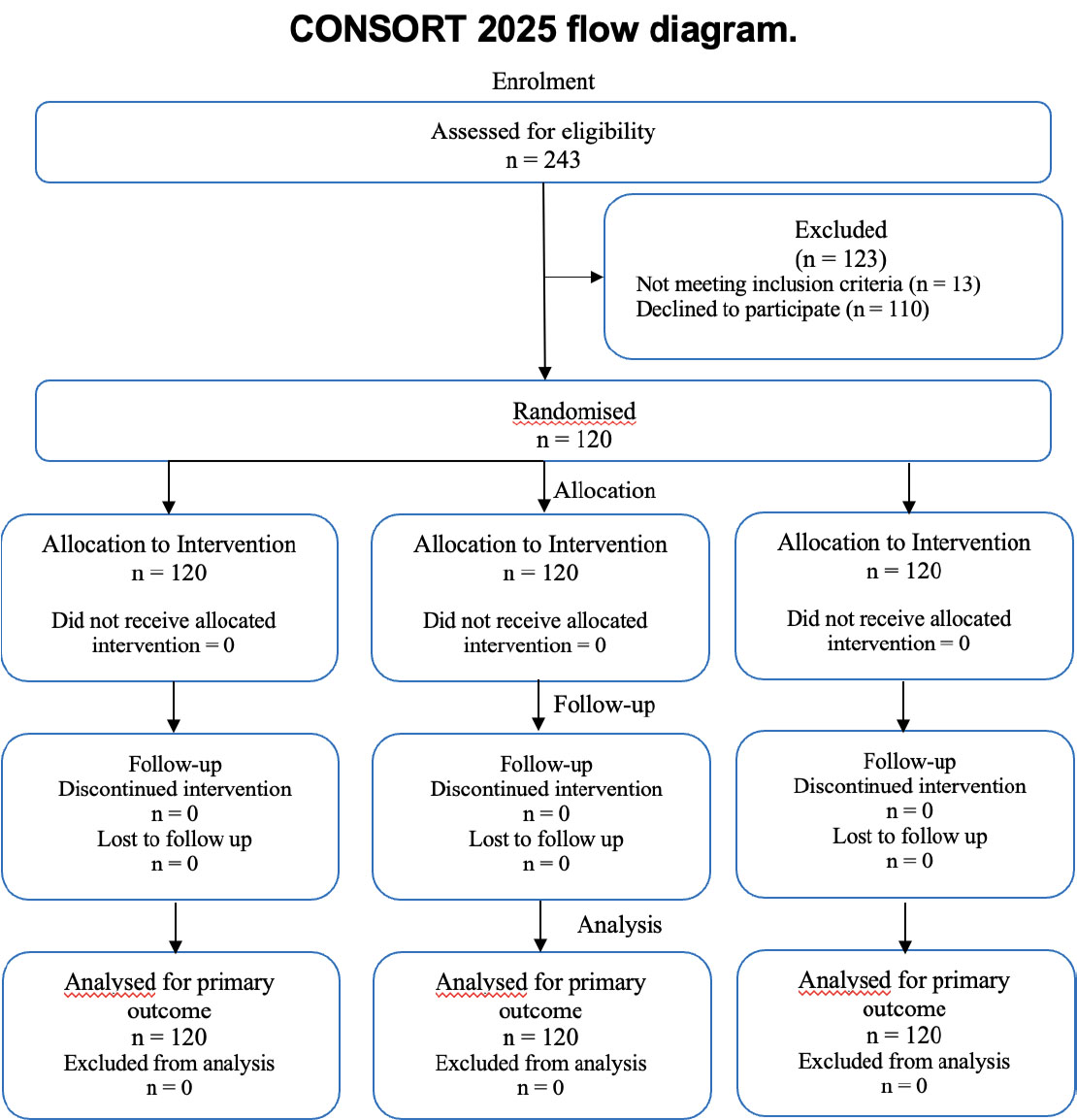
CONSORT flow diagram of participant enrolment, randomization, allocation, follow-up, and analysis in this randomized crossover trial.
Each patient underwent all three preoxygenation techniques: TVB for 3 minutes at 5 L/min FGF, DB for 1 minute at 5 L/min FGF, and DB for 1 minute at 10 L/min FGF in a randomized order. The sequence of techniques was generated by drawing lots. The investigator was responsible for sequence generation, patient enrollment, and assignment, which did not permit allocation concealment and is acknowledged as a limitation. A 15-minute period of room-air breathing separated each technique to allow washout, and baseline measurements were obtained during room-air breathing immediately before each test. As the breathing technique could not be concealed, blinding of participants and the administering clinician was not feasible. Outcome assessment and data analysis were also unblinded. Before anesthetic induction, all techniques were explained to patients to familiarize them with mask breathing and ensure an adequate mask seal. A standardized anesthesia machine (Aestiva 5/Compact; Datex-Ohmeda, Madison, WI) was used for all subjects. The breathing circuit consisted of a circle absorber system with an Ohmeda GMS absorber containing USP-grade sodium hydroxide lime, disposable 60-inch corrugated breathing tubes, and a 3-L natural latex reservoir bag pre-inflated using the oxygen flush valve. Preoxygenation was administered with 100% oxygen via a well-fitting face mask, with all subjects positioned supine.
During TVB, patients were cued to sustain normal tidal volume and respiratory rate. During DB, patients were prompted to take a deep breath every 7.5 seconds, corresponding to approximately 4 breaths by 30 seconds and 8 breaths by 60 seconds. InspO2, ETO2, ETCO2, and Respiratory Rate (RR) were recorded continuously and are reported at 30-second intervals.
The predefined primary outcome was the proportion of patients achieving the target ETO2 ≥90% within the observation period for each technique, reported with 95% confidence intervals. Secondary outcomes (InspO2, ETCO2, RR) were analyzed using repeated-measures ANOVA. Because TVB was measured at six timepoints (30–180 seconds) while the two DB conditions were measured only at 30 and 60 seconds, a 3(technique) × 2(time) repeated-measures ANOVA was used for between-technique comparisons at the two shared timepoints, and a separate one-way repeated-measures ANOVA characterized the TVB time course across all six timepoints. Mauchly's test was used to assess sphericity; where violated, the Greenhouse-Geisser correction was applied. Pairwise post-hoc comparisons between techniques used paired Student's t-tests with Holm-Bonferroni correction for multiple comparisons [23] and are reported as mean difference with 95% confidence interval. Time to attainment of the target ETO2 ≥90% was compared between FGF levels (5 vs. 10 L/min, within the DB technique) using Kaplan-Meier estimation and the log-rank test, as previously described by Baraka et al. [14]. The event was defined as ETO2 first reaching ≥90%; patients not reaching this threshold within the observation window were censored at their last recorded timepoint. Assuming a paired (crossover) design, 80% power, a small-to-moderate standardized effect size (dz = 0.3), and a two-sided α of 0.0167 (Holm-adjusted for three pairwise comparisons), a minimum of 120 participants would be required. There were no missing data among the recorded measurements. All analyses were performed in SPSS. A p-value of <0.05 was considered statistically significant.
3. RESULTS
Following the inclusion and exclusion criteria, 120 patients with 60 females and 60 males were enrolled in this study, each undergoing all three preoxygenation techniques in a randomized order (Table 1). Mean values of all measured variables at each time point are provided in Supplementary Table S1.
| - |
Total Population (N = 120) |
|---|---|
| Age (years) | 29.60 ± 5.87 |
| Weight (kg) | 59.55 ± 7.03 |
| Height (cm) | 165.75 ± 6.20 |
| BMI (kg/m2) | 21.60 ± 2.10 |
Figure 2 shows that InspO2 remained essentially unchanged throughout the 3-minute TVB observation period, with a mean of 94.75% at 5 L/min FGF. In contrast, deep breathing showed a significant FGF-dependent increase in InspO2, rising from 80.29% to 87.63% at 30 seconds and from 83.63% to 92.58% at 60 seconds as FGF increased from 5 to 10 L/min. A 3(technique) × 2(time) repeated-measures ANOVA confirmed significant main effects of technique (F(2,238) = 425.6, p < 0.001) and time (F(1,119) = 253.8, p < 0.001), and a significant technique × time interaction (F(5,595) = 16.1, p < 0.001). Holm-corrected paired comparisons showed significantly higher InspO2 with TVB than with either deep-breathing condition at 30 seconds (vs. DB-5 L/min: mean difference 9.71, 95% CI 8.94–10.48, p < 0.001; vs. DB-10 L/min: 2.38, 95% CI 1.95–2.80, p < 0.001) and at 60 seconds (vs. DB-5 L/min: 8.33, 95% CI 7.36–9.31, p < 0.001), but not significantly different from DB-10 L/min at 60 seconds (mean difference −0.62, 95% CI −1.63 to 0.38, p = 0.21). InspO2 was also significantly higher with 10 L/min than 5 L/min FGF during deep breathing at both timepoints (30 s: mean difference −7.33, 95% CI −8.12 to −6.55, p < 0.001; 60 s: −8.96, 95% CI −10.16 to −7.76, p < 0.001).
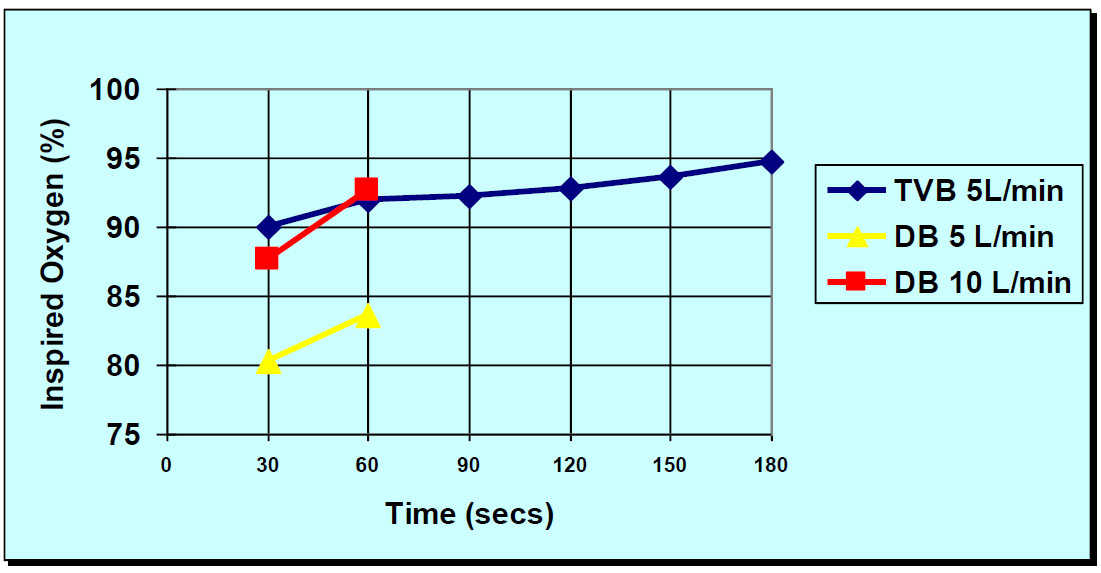
Mean inspired oxygen concentration (InspO2) over time during Tidal Volume Breathing (TVB) at 5 L/min and Deep Breathing (DB) at 5 and 10 L/min fresh gas flow.
Figure 3 shows the corresponding ETO2 trends. All patients reached the target ETO2 ≥90% by 3 minutes of TVB, with values rising from 60.83% at 30 seconds and plateauing at 87.08% by 2.5 minutes at a FGF of 5 L/min. Following 4 deep breaths in 30 seconds, ETO2 increased to 78.29% at 5 L/min FGF and 82.67% at 10 L/min FGF, a statistically significant difference (mean difference 4.38, 95% CI 3.40–5.35, p < 0.001). When deep breathing was extended to 8 breaths over 1 minute, ETO2 reached 91.29% at 10 L/min FGF, with all patients attaining the ≥90% target. This is comparable to 81.21% at 5 L/min FGF, where no patient reached the target within the 60-second observation window (mean difference 10.08, 95% CI 9.37–10.80, p < 0.001). Kaplan-Meier analysis showed that median time to reach ETO2 ≥90% was 60 seconds with deep breathing at 10 L/min FGF, whereas the median was not reached within the 60-second observation window at 5 L/min FGF (log-rank p < 0.0001). The ETO2 value at 8 deep breaths in 1 minute using 10 L/min (91.29%) showed no statistically significant difference from TVB at 3 minutes (91.63%; mean difference 0.34, p = 0.9149).
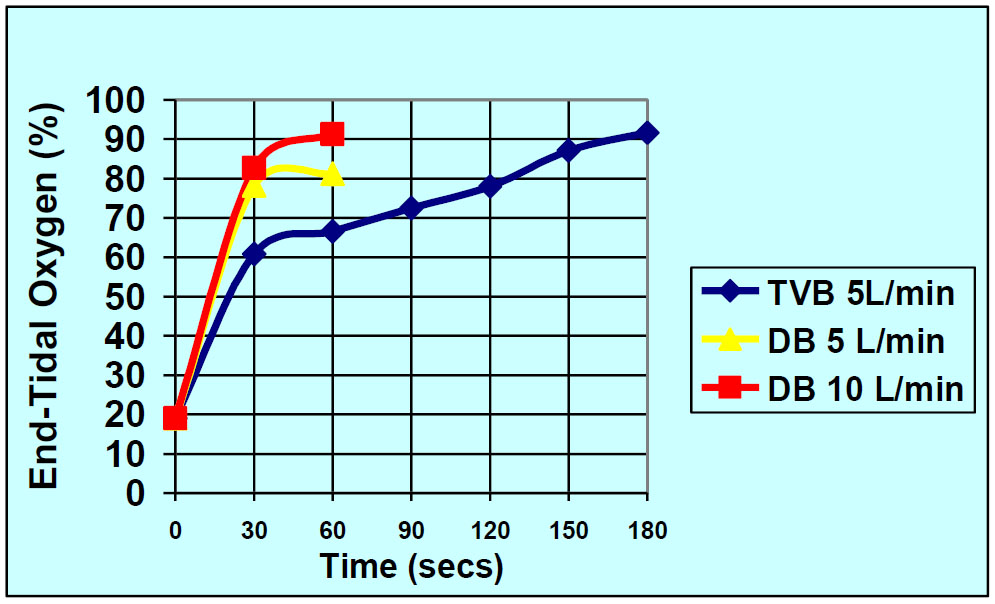
Mean End-tidal Oxygen Concentration (ETO2) over time during Tidal Volume Breathing (TVB) at 5 L/min and Deep Breathing (DB) at 5 and 10 L/min fresh gas flow.
Tidal volume breathing produced a significant decline in mean ETCO2 over time (one-way repeated-measures ANOVA with Greenhouse-Geisser correction: F(5,115) = 357.6, p < 0.001), falling from 27.74 mmHg at 30 seconds to 21.00 mmHg at 180 seconds, but no significant change in respiratory rate (F(5,115) = 2.45, p = 0.038 uncorrected; p = 0.094 after Greenhouse-Geisser correction). Deep breathing elicited a more pronounced hypocapnic response than TVB, with ETCO2 declining to 23.88 and 22.63 mmHg at 30 seconds using 5 and 10 L/min FGF, respectively (both significantly lower than TVB at the same timepoint, Holm-corrected p < 0.001), and to 22.25 and 20.63 mmHg at 60 seconds with 8 deep breaths (Fig. 4).
During observation in the recovery room, 5 of 120 patients experienced transient dizziness and 1 experienced transient nausea, both following the deep-breathing techniques. No other complications occurred.
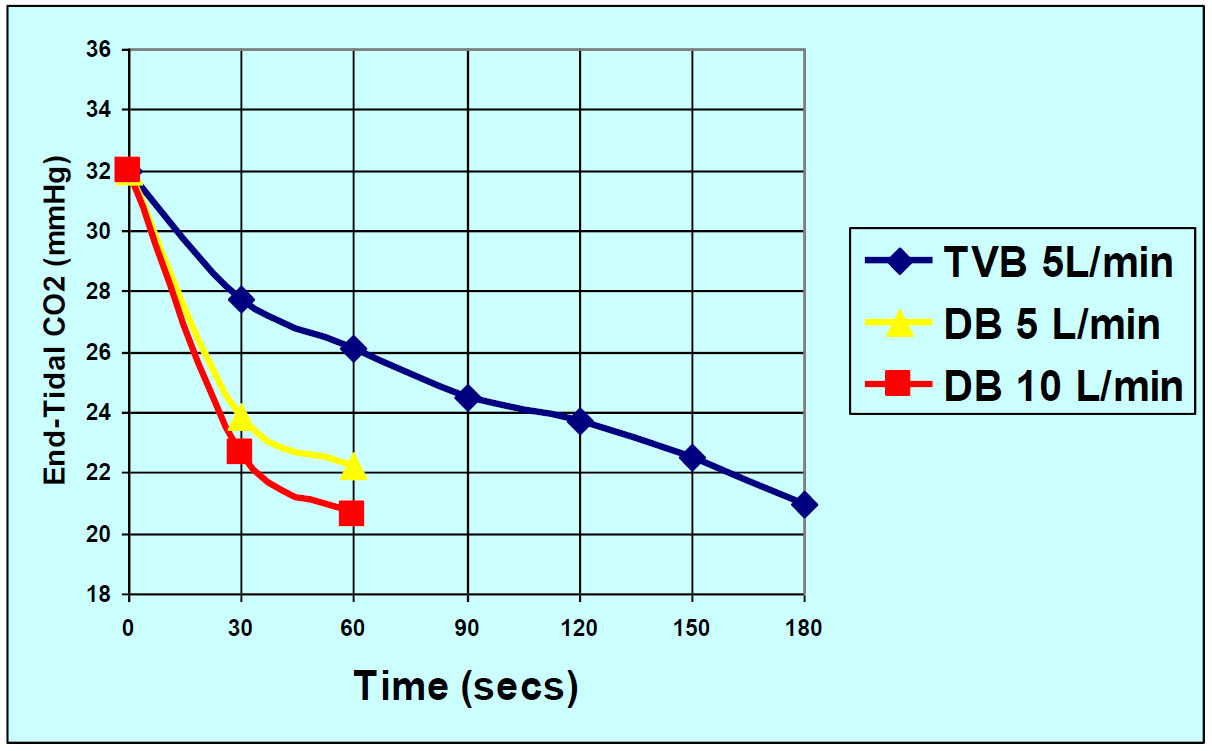
Mean End-tidal Carbon Dioxide (ETCO2) over time during Tidal Volume Breathing (TVB) at 5 L/min and Deep Breathing (DB) at 5 and 10 L/min fresh gas flow.
4. DISCUSSION
This study shows that tidal volume breathing for 3 minutes reliably achieves the ETO2 ≥90% target, a widely used surrogate marker of preoxygenation adequacy, within this timeframe. This finding is consistent with existing literature [14, 20, 21] and supports the continued use of tidal-volume breathing as a commonly used technique, though ETO2 attainment alone does not confirm improved safe apnea time or clinical outcomes. Increased Fresh Gas Flow (FGF) from 5 to 10 L/min did not significantly enhance ETO2 during tidal volume breathing. In comparison, the 4-deep-breath-in-30-second checkpoint resulted in suboptimal preoxygenation, with none of the subjects achieving the target ETO2 of ≥90%. This suggests that, although appealing in time-constrained situations, the technique does not allow sufficient time for complete denitrogenation, particularly in the tissue and venous compartments [24]. Additionally, increasing FGF did not significantly improve outcomes at this early checkpoint, likely due to a mismatch between high inspiratory demand and the available fresh gas flow, resulting in entrainment of exhaled gases and a reduced inspired oxygen concentration.
Extending deep breathing to the full one minute significantly improved preoxygenation efficiency, particularly when combined with higher FGF (10 L/min). Under these conditions, ETO2 values showed no statistically significant difference from tidal volume breathing, though this was not formally tested for equivalence. This finding shows the importance of adequate duration and sufficient fresh gas flow in optimizing deep breathing techniques. The improved performance at higher FGF may be explained by reduced rebreathing and increased inspired oxygen concentration during periods of high minute ventilation [25].
An important physiological consideration is that effective preoxygenation involves not only alveolar oxygenation but also oxygen loading of tissue and venous compartments. Rapid breathing techniques can achieve high alveolar oxygen concentrations quickly, but the limited time may limit oxygen storage in peripheral compartments, resulting in faster desaturation during apnea [1, 3]. This may explain the inferior performance of the 4-deep-breath checkpoint despite relatively high inspired oxygen levels.
The incidence of transient dizziness observed with deep breathing is clinically notable and warrants closer consideration. This most likely reflects acute hypocapnia from hyperventilation exceeding metabolic CO2 production, resulting in cerebral vasoconstriction and a transient reduction in cerebral blood flow [26]. A related but distinct concern is the Bohr effect: acute hypocapnia left-shifts the oxyhemoglobin dissociation curve, increasing hemoglobin's affinity for oxygen and potentially impairing its unloading to tissues. While these symptoms were transient and self-limited in this healthy ASA I cohort, the physiological basis for them raises a caution for populations in whom acute reductions in cerebral perfusion carry more risk, including patients with cerebrovascular disease, epilepsy, or raised intracranial pressure [27].
This study has several limitations. It was conducted in ASA I patients undergoing elective peripheral surgery with normal cardiopulmonary physiology, which may limit generalizability to patients with reduced functional residual capacity or impaired oxygenation. Furthermore, although this study has been ethically approved at our institution, it was not registered in any prospective clinical trial databases. Blinding of participants, the administering clinician, outcome assessors, and the statistician was not feasible given the nature of the interventions. Adverse events were not tracked by fresh gas flow condition, limiting mechanistic interpretation of the observed dizziness and nausea. Additionally, surrogate markers such as ETO2 were used to assess preoxygenation efficacy rather than clinical outcomes such as time to desaturation. Future studies should address these limitations with a priori sample-size planning, independent allocation concealment, more diverse patient populations, and clinically meaningful endpoints. Furthermore, adjuncts that may also enhance oxygenation and prolong safe apnea time, such as head-up positioning, application of positive airway pressure (PEEP or CPAP), and apneic oxygenation using nasal cannula or High-flow Nasal Oxygen (HFNO), may also be investigated.
CONCLUSION
This study shows that tidal-volume breathing for 3 minutes was the most consistent method for achieving the ETO2 ≥90% target in a circle absorber system. As ETO2 is a physiological surrogate, this does not by itself demonstrate improved safe apnea time or clinical outcomes. Deep breathing showed no statistically significant difference from TVB in ETO2 only when performed for the full 1 minute with high fresh gas flow. Further research with a priori sample-size planning, investigating adjuncts to optimize preoxygenation such as positioning, apneic oxygenation, and positive end-expiratory pressure, may also be conducted.
AUTHORS’ CONTRIBUTIONS
C.J., E.M.: Study conception and design; E.M.: Data collection; EM, C.J.: Analysis and interpretation of results; C.J.: Draft manuscript; All authors reviewed the results and approved the final version of the manuscript.
LIST OF ABBREVIATIONS
| ANOVA | = Analysis of Variance |
| ASA | = American Society of Anesthesiologists |
| BMI | = Body Mass Index |
| CONSORT | = Consolidated Standards of Reporting Trials |
| CPAP | = Continuous Positive Airway Pressure |
| DB | = Deep Breathing |
| ETCO2 | = End-Tidal Carbon Dioxide |
| ETO2 | = End-Tidal Oxygen |
| FGF | = Fresh Gas Flow |
| FRC | = Functional Residual Capacity |
| GMS | = Gas Management System |
| HFNO | = High-Flow Nasal Oxygen |
| InspO2 | = Inspired Oxygen Concentration |
| IRB | = Institutional Review Board |
| PEEP | = Positive End-Expiratory Pressure |
| RR | = Respiratory Rate |
| RSI | = Rapid Sequence Induction |
| TVB | = Tidal Volume Breathing |
| USP | = United States Pharmacopeia |
ETHICS APPROVAL AND CONSENT TO PARTICIPATE
This study obtained ethical approval from the Institutional Review Board (Faculty of Medicine, Pelita Harapan University), headed by Prof. Dr. dr. Cucunawangsih, Sp.MK (K), in November 2025, with approval number 247/K-LKJ/ETIK/XI/2025.
HUMAN AND ANIMAL RIGHTS
All procedures involving human participants were conducted in accordance with the ethical standards of the committee responsible for human experimentation (institutional and national), and with the Helsinki Declaration of 1975, as revised in 2013.
AVAILABILITY OF DATA AND MATERIALS
Data is available in the Pelita Harapan University database and may be obtained via personal and formal requests to the aforementioned party.
ACKNOWLEDGEMENTS
Declared none.