All published articles of this journal are available on ScienceDirect.

Impact of Neuromuscular Blockade Reversal on Emergence Agitation in Adults Undergoing Nasal Surgery: A Prospective Randomized Controlled Trial
 iD
Rabah Salem Rabah Alharbi2
iD
Mohamad Saud Mohamad Alzayed3
Authors Info & Affiliations
Abstract
Introduction/Objective
Emergence Agitation (EA) is a concern during recovery from general anesthesia, particularly after nasal surgery, where airway discomfort may contribute to agitation. This study aimed to compare the incidence and severity of EA in adults undergoing nasal surgery who received sugammadex or neostigmine for neuromuscular blockade reversal.
Methods
This prospective, randomized controlled trial included 154 adults with American Society of Anesthesiologists (ASA) physical status I or II undergoing nasal surgery under general anesthesia. Patients were randomly allocated to receive either sugammadex (2 mg/kg intravenously) or neostigmine (0.05 mg/kg intravenously) combined with glycopyrrolate (0.01 mg/kg intravenously). EA was assessed at extubation and at 5 and 10 minutes afterward. Secondary outcomes included time to full consciousness, the interval to extubation following neuromuscular recovery, hemodynamic variables, and postoperative complications.
Results
The incidence of EA was lower in the sugammadex group than in the neostigmine group (9/77 [11.7%] vs. 26/77 [33.7%], respectively; p < 0.001). Time to full consciousness was shorter in the sugammadex group (10.8 ± 5.1 vs. 15.6 ± 6.8 minutes, respectively; p < 0.001). The interval from a TOF count greater than 2 to extubation after achieving a TOF ratio ≥ 0.9 was also shorter in the sugammadex group (2.78 ± 1.09 vs. 5.20 ± 1.47 minutes, respectively; p < 0.001). EA scores were lower in the sugammadex group, with significant group, time, and group-by-time interaction effects on repeated-measures analysis. No statistically significant differences were observed in rescue sedation requirements or postoperative nasal bleeding among patients who developed EA.
Discussion
The findings suggest that the choice of neuromuscular blockade reversal agent may be associated with emergence characteristics after nasal surgery. Faster recovery with sugammadex may partly explain the observed differences; however, the contribution of Residual Neuromuscular Blockade (RNMB) to EA could not be directly established because quantitative TOF recovery was not evaluated as a study outcome.
Conclusion
Sugammadex use was associated with a lower incidence and severity of EA and faster recovery to full consciousness than neostigmine in adults undergoing nasal surgery. These findings should be interpreted cautiously because surgical duration differed between groups and other perioperative factors may have influenced the results. Further studies incorporating quantitative neuromuscular monitoring and adjustment for potential confounders are warranted.
1. INTRODUCTION
Emergence Agitation (EA) is a common problem during recovery from general anesthesia, particularly after nasal surgery. It is characterized by restlessness, disorientation, and, in some cases, aggressive or violent behavior. Although EA is more commonly reported in children, it can also occur in adults and may result in complications such as bleeding, self-extubation, removal of surgical dressings, and injury to patients or healthcare personnel [1-3].
Patients undergoing nasal surgery may be particularly prone to EA because several factors can make the emergence period uncomfortable. Nasal packing, airway irritation, blood in the pharynx, and difficulty breathing through an obstructed nose can all contribute to respiratory discomfort as patients regain consciousness. Along with the residual effects of anesthetic agents, these factors may increase the risk of EA during recovery [4, 5].
Residual Neuromuscular Blockade (RNMB) is another potential contributor to EA that has received less attention. Incomplete recovery of neuromuscular function during emergence may impair ventilation and upper airway function, which could increase respiratory discomfort and contribute to agitation [6]. Neostigmine, a commonly used reversal agent, is an acetylcholinesterase inhibitor that increases acetylcholine levels at the neuromuscular junction and enhances neuromuscular transmission. However, even when an appropriate dose is administered, complete recovery of neuromuscular function may not always be achieved [7]. Sugammadex is a selective relaxant-binding agent that reverses rocuronium-induced neuromuscular blockade by binding to rocuronium in the plasma and reducing its availability at the neuromuscular junction. Compared with neostigmine, sugammadex provides faster and more predictable recovery of neuromuscular function, particularly in patients with moderate or deep neuromuscular blockade [8, 9]. This more reliable recovery may be particularly relevant during emergence after nasal surgery, when airway obstruction and respiratory discomfort may increase the risk of agitation.
This study aimed to investigate whether the choice of neuromuscular reversal agent was associated with the incidence and severity of EA. We compared the sugammadex group with the neostigmine group in adults undergoing nasal surgery, focusing on EA, recovery characteristics, and perioperative hemodynamic stability.
2. MATERIALS AND METHODS
2.1. Study Design and Setting
This was a prospective, parallel-group, randomized controlled trial with a 1:1 allocation ratio. The study was conducted at King Salman Specialist Hospital, Hail Cluster, Saudi Arabia, between October 2025 and March 2026. The study protocol was approved by the Institutional Review Board (KASC-2025-77) and registered with ClinicalTrials.gov (NCT07253428) before patient enrollment.
Written informed consent was obtained from all participants before enrollment in the study. Artificial intelligence tools were used to assist with manuscript preparation and language editing. All authors reviewed the final manuscript and confirmed the accuracy and integrity of the reported data.
2.2. Participants
A total of 154 patients aged 18–60 years with ASA physical status I or II were enrolled. All patients were scheduled to undergo nasal surgery under general anesthesia, including rhinoplasty, septoplasty, or endoscopic sinus surgery. Patients were excluded if they had a known allergy to any of the study medications, renal or hepatic disease, neurological or psychiatric disorders, or a suspected difficult airway.
2.3. Randomization and Blinding
Participants were randomly assigned to either the sugammadex group or the neostigmine group using a computer-generated randomization sequence with a 1:1 allocation ratio. To maintain allocation concealment, treatment assignments were placed in sequentially numbered, opaque, sealed envelopes. The envelopes were opened only by the designated anesthesia technician, who prepared the study medication. The anesthesiologist responsible for assessing emergence agitation was not involved in the allocation process and remained unaware of the treatment assignment throughout the assessment period.
2.4. Drug Administration
In the sugammadex group, sugammadex (2 mg/kg intravenously) was administered when the Train-of-Four (TOF) count was at least 2. In the neostigmine group, neostigmine (0.05 mg/kg intravenously) combined with glycopyrrolate (0.01 mg/kg intravenously) was administered when the TOF count was at least 2. The anesthesiologist who assessed EA remained blinded to the treatment group throughout the assessment period.
2.5. Anesthesia Technique
All patients were premedicated with midazolam (0.02 mg/kg). Anesthesia was induced with fentanyl (1 µg/kg) and propofol (2 mg/kg), followed by rocuronium (0.6 mg/kg). After intubation, anesthesia was maintained with an oxygen/air mixture and sevoflurane at 1–1.5 times Minimum Alveolar Concentration (MAC). Normocapnia was maintained by adjusting the ventilation parameters for each patient.
Neuromuscular blockade was monitored using an NMT pod (Dräger Medical Systems, Telford, PA, USA), with surface electrodes placed over the ulnar nerve and adductor pollicis muscle. After induction of anesthesia and before rocuronium administration, the device was calibrated according to the manufacturer's recommendations. TOF stimulation was then used to assess the depth of neuromuscular blockade and subsequent recovery.
During maintenance of anesthesia, a TOF count of ≤ 2 was considered adequate for surgical relaxation. At the end of surgery, neuromuscular blockade was reversed according to the assigned treatment group once the TOF count was > 2. TOF monitoring was continued until the TOF ratio reached ≥ 0.9. Extubation was performed after a TOF ratio ≥ 0.9 was confirmed, along with adequate spontaneous ventilation and evidence of consciousness. The time from a TOF count > 2 to extubation was recorded. In the Post-Anesthesia Care Unit (PACU), all patients were closely monitored and managed according to their clinical condition. Additional sedative medication was administered when the agitation score was > 4.
2.6. Outcome Measures
The primary outcome was the incidence of EA within 10 minutes after extubation. Secondary outcomes included the severity of agitation, assessed by a blinded healthcare observer using the Riker Sedation-Agitation Scale (SAS), a 7-point scale ranging from 1 (unarousable) to 7 (dangerous agitation). A score of 4 indicates a calm and cooperative patient, whereas scores of 5–7 indicate increasing levels of agitation, ranging from restlessness that responds to reassurance to severe agitation requiring intervention [10]. The time from administration of the reversal agent to extubation after achieving a TOF ratio ≥ 0.9 was recorded. Time to full consciousness, Patient State Index (PSI) scores during recovery, and hemodynamic variables, including mean Arterial Pressure (MAP) and Heart Rate (HR), were also evaluated. Time to full consciousness was defined as the interval from discontinuation of anesthetic administration until the PSI exceeded 80. PSI is a quantitative electroencephalography-derived index ranging from 0 (indicating deep anesthesia) to 100 (indicating full wakefulness) and was monitored using the Masimo SedLine® system. In this study, a PSI > 80 was used as the predefined criterion for recovery to an awake state [11].
2.7. Statistical Analysis
The sample size was calculated using Stata version 17.0 (StataCorp, USA). The calculation was based on a previous study by Kim et al. involving children undergoing strabismus surgery, which reported expected EA rates of 28.1% in the sugammadex group and 50% in the neostigmine group [12]. These figures were used as a reference when estimating the required sample size. However, because the earlier study involved children undergoing eye surgery rather than adults undergoing nasal surgery, the expected rates may not fully reflect the population included in our study. With a two-sided significance level of 0.05 and a statistical power of 80%, the required sample size was estimated at 77 patients per group, for a total of 154 patients. The initial recruitment target was increased to 162 patients to account for a possible 5% loss of participants or incomplete data.
IBM SPSS Statistics version 25.0 (IBM Corp., Armonk, NY, USA) was used for all statistical analyses. The Shapiro–Wilk test was used to assess the normality of continuous variables. Continuous variables were compared using the independent-samples t-test for normally distributed data and the Mann–Whitney U test for non-normally distributed data, as appropriate. Continuous variables are presented as mean ± Standard Deviation (SD). Categorical variables were analyzed using the chi-square test or Fisher's exact test, as appropriate.
The incidence of EA was analyzed as a categorical outcome. EA scores recorded at T0, T5, and T10 were compared between the two groups using repeated-measures analysis of variance, provided that the required assumptions were met. Differences between the two groups over time were assessed using the group-by-time interaction, as well as the main effects of group and time. Where appropriate, estimated between-group differences were reported together with their 95% confidence intervals. Statistical significance was defined as p < 0.05.
3. RESULTS
Of the 162 patients initially recruited, eight were excluded due to insufficient follow-up data or loss of blinding. The final analysis included 154 patients, with 77 patients in each group (Fig. 1).
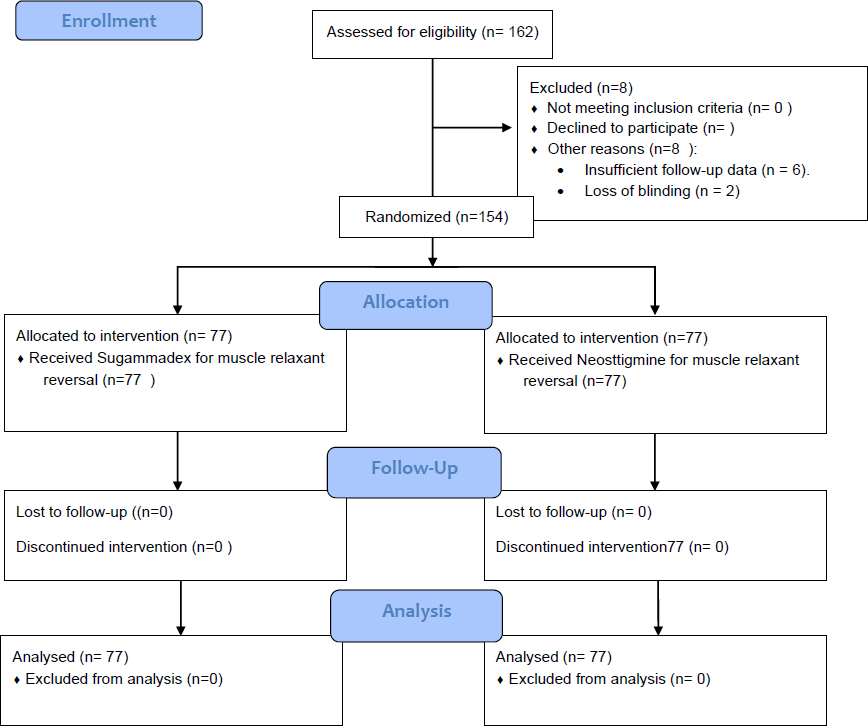
CONSORT flow diagram of patient selection throughout the trial. The diagram summarizes patient screening, exclusions with reasons, randomization, allocation to the study groups, follow-up, and inclusion in the final analysis.
The demographic and perioperative characteristics of the two groups are presented in Table 1. Overall, the groups were similar in terms of age, sex, body weight, and duration of anesthesia. The sugammadex group included 51 males (66.2%) and 26 females (33.8%), while the neostigmine group included 53 males (68.8%) and 24 females (31.2%). The difference in sex distribution was not statistically significant (p = 0.730). The mean age was 33.7 ± 9.6 years in the sugammadex group and 32.5 ± 10.1 years in the neostigmine group (p = 0.225). Similarly, mean body weight was 73.25 ± 10.5 kg and 72.39 ± 9.6 kg, respectively (p = 0.300). The duration of anesthesia was also comparable between the groups (83.75 ± 16.0 vs. 81.9 ± 13.0 minutes; p = 0.225). However, surgery lasted significantly longer in the sugammadex group than in the
| Variable | Sugammadex Group (n = 77) | Neostigmine Group (n = 77) | p-value |
|---|---|---|---|
| Age (years), mean ± SD | 33.7 ± 9.6 | 32.5 ± 10.1 | 0.225 |
| Sex, n (%) | |||
| Male | 51 (66.2%) | 53 (68.8%) | 0.730 |
| Female | 26 (33.8%) | 24 (31.2%) | |
| Weight (kg), mean ± SD | 73.25 ± 10.5 | 72.39 ± 9.6 | 0.300 |
| Duration of surgery (min), mean ± SD | 80.1 ± 15.7 | 74.48 ± 12.67 | 0.016* |
| Duration of anesthesia (min), mean ± SD | 83.75 ± 16.0 | 81.9 ± 13.0 | 0.225 |
neostigmine group (80.1 ± 15.7 vs. 74.48 ± 12.67 minutes; p = 0.016).
Hemodynamic findings are summarized in Table 2. No significant differences were observed between the groups in Heart Rate (HR) or Mean Arterial Pressure (MAP), either at baseline or after extubation. Baseline HR was 84.0 ± 10.8 beats/min in the sugammadex group and 86.3 ± 12.4 beats/min in the neostigmine group (p = 0.110). After extubation, the corresponding values were 84.8 ± 6.9 and 84.8 ± 9.6 beats/min (p = 0.480). Baseline MAP was 82.1 ± 11.0 mmHg in the sugammadex group and 85.0 ± 12.3 mmHg in the neostigmine group (p = 0.059). Post-extubation MAP was 82.3 ± 9.2 and 84.1 ± 9.2 mmHg, respectively (p = 0.062).
| Variable | Sugammadex Group (n = 77) | Neostigmine Group (n = 77) | p-value |
|---|---|---|---|
| Baseline HR (beats/min), mean ± SD | 84.0 ± 10.8 | 86.3 ± 12.4 | 0.110 |
| Post-extubation HR (beats/min), mean ± SD | 84.8 ± 6.9 | 84.8 ± 9.6 | 0.480 |
| Baseline MAP (mmHg), mean ± SD | 82.1 ± 11.0 | 85.0 ± 12.3 | 0.059 |
| Post-extubation MAP (mmHg), mean ± SD | 82.3 ± 9.2 | 84.1 ± 9.2 | 0.062 |
Emergence and recovery outcomes are presented in Table 3. The Patient State Index (PSI) score at extubation was higher in the sugammadex group than in the neostigmine group (78.1 ± 8.4 vs. 73.6 ± 6.4; p = 0.001). Patients who received sugammadex also regained full consciousness more quickly, with a mean time of 10.8 ± 5.1 minutes compared with 15.6 ± 6.8 minutes in the neostigmine group (p < 0.001). Full consciousness was defined as a PSI score greater than 80. The interval from a Train-of-Four (TOF) count greater than 2 to extubation after achieving a TOF ratio of at least 0.9 was also shorter in the sugammadex group (2.78 ± 1.09 vs. 5.20 ± 1.47 minutes; p < 0.001).
| Variable | Sugammadex Group (n = 77) | Neostigmine Group (n = 77) | p-value |
|---|---|---|---|
| PSI score at extubation, mean ± SD | 78.1 ± 8.4 | 73.6 ± 6.4 | 0.001* |
| Time to full consciousness, PSI > 80 (min), mean ± SD | 10.8 ± 5.1 | 15.6 ± 6.8 | <0.001* |
| Time from TOF count > 2 to extubation after achieving a TOF ratio ≥ 0.9 (min), mean ± SD | 2.78 ± 1.09 | 5.20 ± 1.47 | <0.001* |
| Emergence agitation (EA), n (%) | 9/77 (11.7%) | 26/77 (33.7%) | <0.001* |
| EA score at T0, mean ± SD | 4.21 ± 0.69 | 5.00 ± 1.25 | <0.001* |
| EA score at T5, mean ± SD | 4.10 ± 0.30 | 4.38 ± 0.58 | 0.001* |
| EA score at T10, mean ± SD | 4.00 ± 0.00 | 4.12 ± 0.36 | 0.003* |
Emergence Agitation (EA) was assessed at extubation (T0) and 5 and 10 minutes afterward (T5 and T10). EA occurred in 9 of 77 patients (11.7%) in the sugammadex group and in 26 of 77 patients (33.7%) in the neostigmine group (p < 0.001). The mean EA scores were lower in the sugammadex group at each assessment. At T0, the scores were 4.21 ± 0.69 and 5.00 ± 1.25, respectively (p < 0.001). At T5, the scores were 4.10 ± 0.30 in the sugammadex group and 4.38 ± 0.58 in the neostigmine group (p = 0.001). At T10, the corresponding scores were 4.00 ± 0.00 and 4.12 ± 0.36 (p = 0.003). Repeated-measures analysis showed a significant group-by-time interaction (F = 5.22, p = 0.007), a significant effect of time (F = 3.12, p = 0.048), and a significant overall group effect (F = 8.96, p < 0.001).
Postoperative outcomes among patients who developed EA are presented in Table 4. Rescue sedation was required in 5 of the 9 agitated patients (55.6%) in the sugammadex group and 8 of the 26 agitated patients (30.8%) in the neostigmine group. Although rescue sedation was more frequent in proportion among agitated patients in the sugammadex group, the difference was not statistically significant (p = 0.160). Postoperative nasal bleeding occurred in 3 of 9 agitated patients (33.3%) in the sugammadex group and 4 of 26 agitated patients (15.4%) in the neostigmine group. This difference was also not statistically significant (p = 0.240).
| Variable | Sugammadex Group (n = 77) | Neostigmine Group (n = 77) | p-value |
|---|---|---|---|
| Emergence agitation (EA), n (%) | 9/77 (11.7%) | 26/77 (33.7%) | <0.001* |
| Postoperative need for rescue sedation among patients with EA, n (%) | 5/9 (55.6%) | 8/26 (30.8%) | 0.160 |
| Postoperative nasal bleeding among patients with EA, n (%) | 3/9 = 33.33% | 4/26 =15.38% | 0.240 |
4. DISCUSSION
Our findings showed that sugammadex use was associated with a lower incidence and severity of Emergence Agitation (EA) than neostigmine use in adults undergoing elective nasal surgery. Patients in the sugammadex group also had lower EA scores and regained full consciousness more quickly. These findings suggest an association between the choice of neuromuscular reversal agent and the quality of emergence after nasal surgery [13].
Emergence can be particularly challenging after nasal surgery because edema, postoperative bleeding, and nasal packing may make nasal breathing difficult as patients regain consciousness. This respiratory discomfort may contribute to agitation during recovery. Therefore, adequate recovery of muscle strength is important for maintaining airway patency and normal protective airway reflexes.
The anesthetic technique may also influence the development of emergence agitation. Total Intravenous Anesthesia (TIVA), particularly propofol-based anesthesia, has been associated with a lower incidence of emergence agitation in some surgical settings and may be a useful approach for reducing EA [14, 15]. However, our study used the standard anesthetic technique at our institution and was specifically designed to compare sugammadex with neostigmine for neuromuscular blockade reversal.
Residual Neuromuscular Blockade (RNMB), even when clinically subtle, may also play a role in postoperative agitation. Neostigmine reverses rocuronium by increasing acetylcholine concentrations at the neuromuscular junction, and its effectiveness depends partly on the timing of administration and the degree of neuromuscular recovery at that time. In patients who already have difficulty breathing through the nose, residual weakness could potentially increase respiratory discomfort and contribute to agitation [8, 9, 16].
Sugammadex reverses rocuronium by directly encapsulating the drug and generally provides more predictable reversal of neuromuscular blockade [17]. This may result in faster and more reliable recovery and could partly explain the lower incidence and severity of EA observed in the sugammadex group.
In our study, reversal was administered when the TOF count was at least 2, and monitoring was continued until a TOF ratio ≥ 0.9 was achieved before extubation. However, quantitative neuromuscular recovery was not prespecified as an outcome, and TOF recovery measurements were not statistically compared between the groups. Therefore, although differences in the speed or completeness of neuromuscular recovery may have contributed to our findings, we cannot conclude that RNMB directly caused the difference in EA. This possible explanation should therefore be interpreted cautiously.
Previous studies have reported improved recovery with sugammadex in several surgical populations [18-21], which is consistent with the recovery findings observed in our study. Our results may be particularly relevant to nasal surgery, where maintaining comfortable breathing during emergence can be challenging. The shorter time to full consciousness observed in the sugammadex group may also be relevant, as it reduces the duration of partial disorientation, during which restlessness and agitation may occur.
Despite the difference in agitation between the groups, we found no significant differences in hemodynamic variables, including HR and MAP. The sympathetic response associated with extubation may occur regardless of the reversal agent used. Therefore, the assessed hemodynamic variables do not appear to account for the observed differences in emergence behavior [5, 22, 23].
Emergence Agitation (EA) occurred less frequently in the sugammadex group than in the neostigmine group (11.7% vs. 33.7%). However, among patients who developed EA, rescue sedation was needed in 5 of 9 patients (55.6%) in the sugammadex group, compared with 8 of 26 patients (30.8%) in the neostigmine group. Although rescue sedation was numerically more common in the sugammadex group, the difference was not statistically significant (p = 0.160). This finding should be interpreted with caution, particularly because the number of patients who developed EA in the sugammadex group was small. The reason for the higher proportion of patients requiring rescue sedation in this group remains unclear. Similarly, postoperative nasal bleeding among patients who developed EA occurred in 3 of 9 patients (33.3%) in the sugammadex group and 4 of 26 patients (15.4%) in the neostigmine group. This difference was also not statistically significant (p = 0.240).
Among patients who developed EA, no significant between-group differences were observed in rescue sedation or postoperative nasal bleeding.
The incidence of Emergence Agitation (EA) was lower in the sugammadex group than in the neostigmine group (11.7% vs. 33.7%). However, this difference did not translate into statistically significant differences in rescue sedation or postoperative nasal bleeding among patients who developed EA. As the study was not specifically designed to assess whether reducing EA could prevent postoperative complications, these findings should be interpreted with caution.
Another factor to consider is the difference in surgery duration between the two groups. Operations lasted significantly longer in the sugammadex group than in the neostigmine group (80.1 ± 15.7 vs. 74.48 ± 12.67 minutes, respectively; p = 0.016). Although patients were randomly assigned to the two groups, this difference may have influenced recovery and the occurrence of EA. Since no adjusted analysis was performed to account for surgery duration, we cannot rule out the possibility that it contributed to the observed differences in EA between the groups.
Although meta-analyses and clinical studies have reported faster neuromuscular recovery with sugammadex than with neostigmine, the effect of the reversal agent on overall recovery quality has varied across surgical populations [24-26]. Differences in patient characteristics, anesthetic techniques, surgical procedures, and outcome definitions may contribute to this variability.
Overall, our findings demonstrate an association between sugammadex use and lower incidence and severity of EA in adults undergoing nasal surgery. More predictable neuromuscular recovery is one possible explanation, but this mechanism could not be confirmed because quantitative TOF recovery was not analyzed as a study outcome. Other perioperative factors may also have contributed to the observed differences.
LIMITATIONS
This study had several limitations. First, although TOF monitoring was used clinically to guide administration of the reversal agents, quantitative TOF recovery data were not collected as a study outcome. Therefore, we could not directly assess whether RNMB was associated with EA.
Second, several potentially relevant perioperative factors, including body mass index, preoperative anxiety, postoperative pain, nasal packing, nausea, hypoxia, hypercapnia, anesthetic and opioid doses, depth of anesthesia, and rocuronium dose, were not collected for statistical analysis. These factors may have contributed to the differences in EA observed between the groups. Third, the duration of surgery was longer in the sugammadex group than in the neostigmine group. This difference may have influenced the study findings, and the possibility of residual confounding cannot be ruled out despite randomization.
Finally, the study was conducted at a single institution and included a relatively limited sample of adults undergoing nasal surgery. Therefore, the generalizability of the findings to other patient populations, surgical procedures, or clinical settings may be limited.
CONCLUSION
Sugammadex use was associated with a lower incidence and severity of emergence agitation than neostigmine use in adults undergoing elective nasal surgery. Patients in the sugammadex group also experienced faster recovery to full consciousness and a shorter interval from a TOF count > 2 to extubation after achieving a TOF ratio ≥ 0.9. More predictable neuromuscular recovery may partly explain these findings; however, the role of RNMB could not be directly assessed because quantitative TOF recovery was not evaluated as a study outcome. Further studies incorporating quantitative neuromuscular monitoring and additional perioperative factors are warranted to clarify the mechanisms underlying the observed association.
AUTHORS' CONTRIBUTIONS
R.A.: Conceptualization; M.A.: Visualization; S.N.B.A.: Writing and editing. All authors reviewed and approved the final manuscript.
LIST OF ABBREVIATIONS
| ASA | = American Society of Anesthesiologists |
| EA | = Emergence Agitation |
| HR | = Heart Rate |
| MAP | = Mean Arterial Pressure |
| NMB | = Neuromuscular Blockade |
| PACU | = Post-anesthesia Care Unit |
| PSI | = Patient State Index |
| RNMB | = Residual Neuromuscular Blockade |
| SAS | = Sedation-Agitation Scale |
| TOF | = Train-of-Four |
ETHICS APPROVAL AND CONSENT TO PARTICIPATE
The study protocol was approved by the Institutional Review Board (KASC-2025-77) and registered with ClinicalTrials.gov (NCT07253428) prior to patient enrollment.
HUMAN AND ANIMAL RIGHTS
No animals were used in this research. All procedures performed in studies involving human participants were in accordance with the ethical standards of institutional and/or research committees and with the 1975 Declaration of Helsinki, as revised in 2013.
CONSENT FOR PUBLICATION
Written informed consent was obtained from all participants before enrollment in the study.
AVAILABILITY OF DATA AND MATERIALS
All the data and supporting material is available within the article.
ACKNOWLEDGEMENTS
The authors would like to thank all the anesthesia technicians and nursing staff at our hospital who assisted with drug preparation and patient care during the conduct of this trial.